Showing posts with label jazz history. Show all posts

Sunday, August 22, 2010

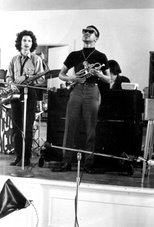
Harry "Sweets" Edison


I met Harry Edison’s mother, Mrs. Kitty Redmond, in 1981. She was living in Poindexter Village, in East Columbus and she was very pleasant and personable. She would tell me about her famous son, where he was traveling in the world and when he would be home.

About the fifth time I visited Miss Kitty, I was finally introduced to Harry and we discussed his career. He told me about his training on bugle as a child with his uncle and his first days on trumpet. He told me he was fourteen in 1930, when he began playing with Earl Hood, the local bandleader who had the local job at Valley Dale Ballroom. He was the “get off” player with Hood, but was having a difficult time getting Earl to give him any money for his work.

Miss Kitty said she marched down to Valley Dale, had a talk with Mr. Hood about her son’s contributions and afterwards Harry began getting regular pay. Mr. Hood insisted that Harry learn to read music, in addition to “getting off.” Harry says that was his key to musical longevity.

Harry’s next job was with the Jeter-Pillars Band, where in his words, he acquired the nickname “Sweets.” According to what I remember Harry saying, “The Jeter-Pillars Band was based in Cleveland and I would ride the train to hook up with the group. My mother would fix a big basket of food for me to travel with and the fellows would call me ‘Sweets’ when I’d get to Cleveland and they would tear into that basket.”

Others stories emerged about Harry’s nickname; his trumpet sound was so sweet, he was sweet with the women, saxophonist Lester Young allegedly gave him the nickname when he joined Count Basie’s Orchestra in 1937. However, despite how he got his nickname, Harry proved to be sweet indeed, with a muted trumpet solo sound that is indescribable delicious.

If you google his name he has over a million pages online. His legend was made in his eleven year with Count Basie that lasted until 1950. In 1944, he played a prominent role in perhaps the finest jazz film ever made, Jammin' the Blues. Basie's orchestra disbanded temporarily in 1950, and thereafter Edison pursued a varied career, leading his own groups, traveling with Jazz at the Philharmonic, and working as a freelance with other orchestras. In the early 1950s he settled on the West Coast, where he became highly sought-after as a studio musician, recording extensively with Frank Sinatra. He regularly led his own group in Los Angeles in the 1960s and he rejoined Count Basie on several occasions.

Harry came home to visit his mother in September, 1983 and offered to play a birthday party for Earl Hood. We had Miss Kitty in the audience at Valley Dale, Harry played two sets with an allstar band of Columbus musicians, including his signature song, Centerpiece and had a wonderful time saluting Mr. Hood at eighty-seven.

Harry continued travel and appearing worldwide, jazz festivals in Europe, concerts in Japan, clubs in the United States. But in 1999, he retired to Columbus, where his daughter, Helena, had settled. He was honored by the Columbus Senior Musicians Hall of Fame in June of that year, wearing a beautiful chocolate brown suit and matching hat as he sat for a photograph that afternoon.

Harry “Sweets” Edison died of cancer the following month, July 27, 1999 at age eighty-two. I served as a pallbearer and played horn for his celebration at the cemetery.

Friday, August 20, 2010

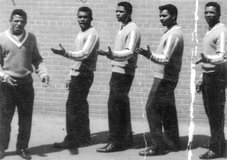
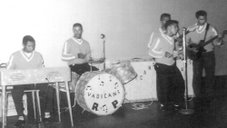
The Columbus Harmonaires: A Conversation with Dave Newlin


On Sunday, Feb. 8, 1998, Dave Newlin, passed into the spirit world after a great life that resulted from his determination to make the best of his existence. I was blessed to meet him in 1980 and spend hours with him on several occasions. His influence on me was as a musician, from his singing with a famed men’s choir, The Harmonaires and as an entrepreneur.

In 1985, he retired to Springfield from employment with Franklin County and was able to enjoy years of good health before his sudden death. but he was a member of a singing group whose success is the stuff that dreams are made.

Would anyone believe a story that begins with two janitors being overheard singing in a closet that blossomed into a national touring show that went to New York, Hollywood and continued for thirty years? It’s true and the center of the saga is the Columbus Harmonaires.

The foundation of this story is the Curtiss-Wright Plant, also known as the North American-Rockwell Plant, on Columbus’ far east side. Many of the nation’s military aircraft were produced there beginning in the 1940’s and the facility continued in aerospace production until the 1980’s.

Before President Franklin Roosevelt’s “New Deal” edict which outlawed discrimination in defense plants, Blacks were employed in strictly custodial or kitchen jobs. A couple of fellows were easing their way through the day’s cleanup by vocalizing in the privacy of their station, when the plant’s manager, C.W. Williams, interrupted their solitude.

The automatic response from the singers was, “Oh no, we’ve been caught. There go our jobs.” But amazingly, Williams’ reaction was joy that such harmony was coming from the workers. He immediately inquired as to their availability to entertain at a party that he was having that night. They accepted and sang the few songs that they knew several times.

The founding members were George Boswell, Fugate Page and Walter Willis, known as the Curtiss-Wright Singers. Williams suggested a new name for the singing group, The Harmonaires, referring to the gospel songs that they first sang as “aires.”

An early member of the group, Dave Newlin, said, “Recreation for Black folk during all ages has been music. If you get three guys under a street lamp, they’d be harmonizing. We had a choir at Curtiss-Wright that had a hundred and fifty voices and we loved to sing.”

When Boswell, Page, Willis and Lawrence McGhee came together, a quartet was ready. They rapidly expanded with the additions of J. Leroy Bowen, Dave Newlin, Edward Ritchie and J. Calvin Ward. Rehearsing in a church, they were overheard by Raglin Reid, an attorney and former member of the Wilberforce University Quartet.
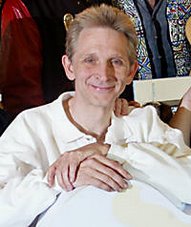
Reid took charge and a group of twelve strong was soon performing statewide in defense related benefits with the backing and sponsorship of Curtiss-Wright. For three years they made weekly appearances on WLW Radio in Cincinnati on the Circle Arrow, Midwestern Hayride and the Sunnywide Shows.

Newlin remarked, “We did some tunes that I’d give anything to have on record; ‘Mighty Like a Rose’ and ‘He.’ Every week we had to have new tunes so we’d rehearse Monday through Friday, four hours a day so we could go to Cincinnati to do the broadcasts.”

“We did some pretty heavy stuff and very seldom did we have orchestration behind us. If there was an orchestra behind us we’d use only the rhythm section because our arrangements were so complete.”

In station wagons purchased by their radio sponsor, the Moores Stores of Newark, Ohio, the Harmonaires touring circle, as singing ambassadors of Curtiss-Wright, extended from Columbus to St. Louis and New York. They performed over five hundred songs at hospitals, civic and benevolent functions.

At war’s end the Harmonaires and Ragland Reid were commended by the War Department for their services. In 1947, still under Reid’s meticulous direction, they headed for New York for even more success.

Two years of storming New York found them on radio with the Carnation Hour, the Jack Smith Show, the Henry Morgan Show, the Arthur Godfrey Show, the Paul Whiteman Show and the Fred Allen Show. Newlin added, “When we did the Carnation Hour, we were forced to write a script for the orchestra behind us. The famous arranger Don Redman wrote the tunes that we were going to do for the eighteen piece orchestra that was on the show. The producer wasn’t going to pay the orchestra and not have them play.”

Newlin also remembers other performers that the Harmonaires worked with including Milton Berle, George Kirby, Spike Jones and their television premier with The Ed Sullivan Show in 1947. “The television lights for the Sullivan show were so hot that we were all wringing wet in no time. It almost burned your skin.”

After three years of non-stop touring, the group returned to Columbus to greet family and friends. J. Leroy Bowen says, “After being away for such a long time the wives really put the pressure on. Ragland Reid resigned and the Harmonaires folded.”

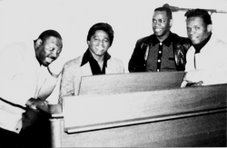
But in late 1949, at the insistence of the Music Corporation of America (MCA), who wanted to make new plans for the singers, The Harmonaires were reorganized as a quintet. The new group featured Bowen, Newlin, Page, Ed Ritchie, Calvin Ward and pianist Harold Clark.

This group continued in the gospel-spiritual tradition of its previous years but added more popular material. In 1951, the high point came when the New Harmonaires journeyed to Hollywood to be featured in “One Too Many.” The work involved recording seven songs for the soundtrack album.

Show business life and regular appearances continued for the group until 1974. At that time death claimed two members, Clark and Ritchie. The group performed an enormous amount of material, but the history of the Harmonaires survived on three seventy-eight rmp records on Majestic Records. In listening to the recordings of the group, they seem a large group extension of the tradition that started with the Mills Brothers in the 1920’s.

Newlin reminisced, “When I was coming up in the ‘30’s the only thing that a young man had to look forward to was driving a city truck or working at the Post Office. Music gave me the opportunity to travel the country in grand style and be on equal terms with all people, rich and poor.”