During the winter 2007 I got a call from
Connie Tracy, public relations administrator for the
Columbus Regional Airport Authority (CRAA). Since I am weak for Connie, I let her take me to lunch at the Concourse Hotel and over a turkey rueben sandwich, she conned me into doing months of work for no pay, no expenses and I would have to pay for my own supplies. What a deal; how could I say no?
The request that Connie had was to document a history of the legendary
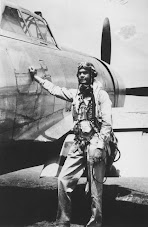
Tuskegee Airmen during the three years that the Black airmen were stationed at
Lockbourne Air Base, beginning in May, 1946. I had done a previous project with Connie and CRAA to commemorate the seventy-fifth anniversary of
Port Columbus International Airport in 2004 and she latched onto my passion for aviation history.
This was an invitation that was easy to get excited about, since I had started to accumulate bits of the Lockbourne Air Base saga from musicians and retirees that I had met, who had shared with me first hand stories of their journeys to Columbus from the South to become a part of the postwar Air Force. Those Tuskegee/Lockbourne alumni included trombonist
Art Baskerville, flight controller
Arthur Boudreaux, Ohio Chapter Tuskegee President
Bob Peebles and bomber pilot
Herdon "Don" Cummings.
I had captured, some years, before a videotape that was a PBS broadcast featuring
Ivory (Ike) Mitchell and
Willie Ruff, the musical
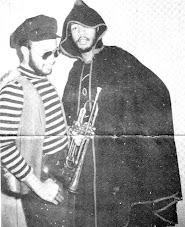
Mitchell-Ruff Duo, that had their beginnings as very young airmen in 1947. This video, on mentoring, told the story of a young airmen being taught music by an older airman and it included photographs and films, with commentary, to illustrate what Lockbourne was like during the late 1940s, “A Sepia Mecca unto itself rising on the Southern Ohio landscape.”
I began my travels into this time machine by calling on my fellow historians
Jeff Darbee and
Nancy Recchie, husband and wife owners of
Benjamin D. Rickey and Company, a consulting firm on historic preservation. They had vacationed in 2001 at
Maxwell Air Force Base, in Alabama and spent their time searching the archives of the
Air Force Historical Research Agency for documents, photographs and squadron reports of the Black airmen during the heyday of racially segregated Army Air Corps, 1941 to 1949,
After months of juggling our schedules, I met with the Darbee-Recchie Family and they produced the box of pages, pictures, discs and slides that had sat in their basement since a February, 2002
Columbus Historical Society presentation that Jeff gave to show slides and introduce the under-publicized story. I looked through the box, separating pages from the images, hoping that I would be trusted to take the images with me to scan and then use imaging software to enhance.
They did allow me to take the box of media home with me, but it sat for the summer, untouched because of my fortieth anniversary tour and big obligations to the 2007 Lancaster Festival. My calendar opened up in early August and I got to the work of scanning, enhancing, printing and sorting over three hundred images, in hopes of producing a book to be introduced at the 2007 Air Show,
Gathering of Mustangs and Legends, September 27-30, 2007 at
Lockbourne/Rickenbacker Air Base.
I also found time to get some days in at the Columbus Main Library, where the Microfiche Department had reels containing the
Ohio State News, the publication that featured news of Black Ohioans during the war years. In three longs days I was able to look at Lockbourne news, from the speculation in January, 1946 that Lockbourne was going become a Negro base full of “troublemakers” to the “death march” that greeted a winning gunnery team when they returned from an Air Force competition in May, 1949. The in-between years had news about
Col. Benjamin O. Davis, Jr. and his "tight ship”, visits from military dignitaries, staff promotions, weddings, track meets, radio model contests, air shows, Army Day parades, football games, visiting bands, special holiday concerts in local clubs, bridge games, the NCO Club, the debut of the
Operation Happiness Show at Memorial Hall, arrests, auto and airplane accidents and airmen’s last rites.
I began printing pictures and gathering caption information to add color to the sixty year old images, many of which were shot by base photographer
Sgt. Bernard Hale. I entered names into search engines, used magnifying lenses to get info from the prints and the slides that were photographs of squadron reports with pictures stapled to them.
Aside from the well-documented hero and base commander, Col. Davis, a most fascinating personality unearthed from the Darbee’s photo treasures was
Lt. Willard W. "Chip” Savoy, the base public relations officer from Washington, D.C. The database search produced a book title under Lt. Savoy’s authorship,
Alien Land; a 1949 publication about a man of light complexion who is pressured by the two racial identities that he exists in. I found an original copy on Amazon.com and it arrived in my mailbox in suprisingly good condition for being printed fifty-eight years previous. I also made contact with his daughter,
Dr. Lauret Savoy, an educator at Mt. Holyoke College in South Hadley, Massachusetts.
Another interesting Lockbourne officer was
Major Vance H. Marchbanks, Lockbourne Army Air Base Surgeon, who was well loved by his fellow airmen because of his skill at keeping them healthy. Later in his military career he played an important role at
National Aeronautics and Space Administration (NASA) in the 1960s. When
Marine Lt. John Glenn circled the earth in the
Friendship 7 capsule, becoming the first American to orbit the earth in space, Marchbanks monitored Glenn’s respiration, pulse, temperature and heartbeat from a base in Kano, Nigeria. Colonel Marchbanks became a pioneer in the field of aeromedical research and later, aerospace medicine.
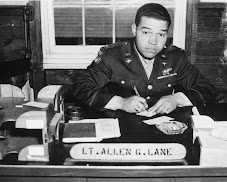
Then there was the beautiful photo of
Lt Allen G. Lane, adjutant of the
100th Fighter Squadron, from Demopolis, Alabama, forced to bail out of his plane set afire by flak bursts over Italy during January, 1944. In early 1949, while returning to Lockbourne from a cross country training flight, his P-47 fighter's engine failed and he died on impact. I found the news story that documented his accident and the young family that was left to grieve him as a hero.
I finished the last of eighty-five display prints on a quality, archival paper on September, 18, 2007. The next day I went into the dry mounting shop with
Bruce and Jan Warner, fellow members of the
Columbus Historical Society, and in four hours we prepared the prints for exhibition. The exhibition will be at the
Gathering of Mustangs and Legends 2007, a four day aviation show, September 27-30th, that is a reunion of one hundred P-51 fighter planes and the legendary men and women pilots that flew them to victory during
World War Two. So thanks to Connie Tracy’s request to take an all-expenses unpaid trip through time, I have delighted in renewing the lost legacy of
Lockbourne Air Base, the Black commanding officer and his Air Force. Col. Davis’ ship was run so tight that it put wheels in motion to integrate the
U.S. Air Force, the U.S. Military and eventually alert American life to the talents of the well-trained
Tuskegee Airmen and America’s people of color.