Thursday, February 24, 2011

January 1959: The Flood In the Bottoms


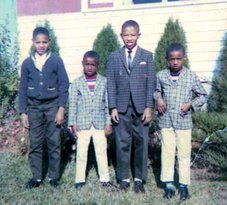
I was eight years old in January, 1959, living on Chicago Avenue and in the third grade at Chicago Avenue School. When the westside levee broke and the flood waters came, I remember my father George Howard, climbing into the crawl space above our ceiling about bed time and turning off the pilot light to our gas furnace. Our parents gave us the sense that we were in an emergency but were not panicked. All four Howard Boys crawled in bed together and body heat kept us warm.

Within a few hours, we were awakened and it was time to evacuate; the Ohio National Guard troop transporter was parked in our flooded street and military men were carrying neighbors in porch chairs to the covered military truck. Our first stop was Engine House Number Ten on West Broad Street and from there, our family was shuttled to the Navy/Marine Recruiting Center located on Sandusky Street at Dublin Road, in the same site that now stands Confluence Park Restaurant.

I remember hundreds of people overnighting there on wooden and canvas, folding cots. After breakfast, ten hours since we were evacuated in the middle of the January night, we contacted our family friends, Otto and Josephine Charles, who had an apartment on Clifton Avenue in East Columbus and spent several days with them, before returning back to the westside.

Flood waters had crept up to our front steps, but no closer and since we had no basement at 175 Chicago Avenue, we saw no flood damage. But our family purchased acreage in Plain City/Union County, built a new home and by November, 1959, we had fled the Bottoms and flooding for good.

Tuesday, February 22, 2011

Frazier Community's Annual Pigroast and Family Day


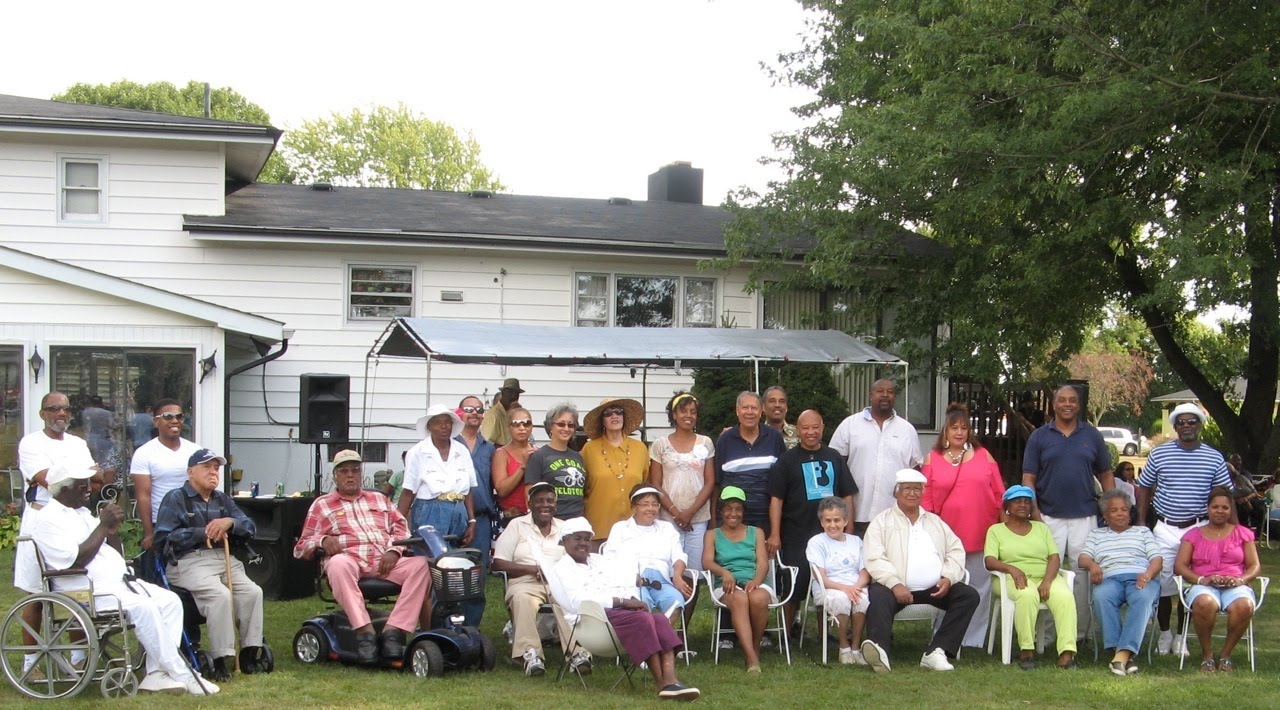
Since 1984, the Frazier Community, Plain City, Ohio and Arnett Howard’s Creole Funk Band have met on Labor Day for a Pigroast and Family Day. As many as seven hundred people have attended this annual celebration from all over the world.

The pigroast started in 1984 as a celebration party when Arnett graduated from the Columbus Area Leadership Program. Art Yoho, of Yoho Foods, contributed the pig, Arnett contributed the music, the Leadership Program made up the guest list, along with the members of the Frazier Community.

The event was enjoyed by all and next year’s event was planned, expanding the guest list to include all friends of Frazier Estates. Friends came from Plain City, Columbus, Cleveland, Boston, Atlanta, Houston, Los Angeles and Munich, Germany, among other places.

There has been only one year that the event has not been held, due to drouth conditions in Plain City. For two years the pigroast was held at the Jerome Township Center in New California, but for the majority of the time the party have been held at the Charles and Virginia Davidson residence, the Eddie Abercrombie residence, the Howard/Bogart residence and the Arnold and Mevelyn Estis residence.

In 2011, the Frazier Community will be hosting its twenty-seventh Pigroast and Family Day. Photos through the years have been assembled and are on display at http://www.flickr.com/photos/59510425@N04/sets/72157625986802051/.

Tuesday, February 1, 2011

Fred and Howard's Studebaker Lark


Fred and Howard’s Studebaker

I was going through the New York Times last week (January 25, 2011) and I ran across an advertisement for a 1960 Studebaker Lark. The ad read, “The frumpy Lark nearly saved Studebaker, but few people saved Larks. It’s an ideal start to a collection of defunct brands. $10,000-$11,000.”

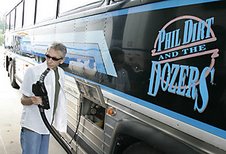
The photo of the plain automobile reminded me of a photo that I took back in 1996 of Fred Holdridge and Howard Burns in front of a Studebaker Lark that they owned. It was getting serviced at the German Village Shell station that was operated by the Vern Thacker family.

I don’t know the year of Fred and Howard’s pristine vehicle but I’m guessing that it was a 1960. According to a page on the Wikipedia website, “The Studebaker Lark is a "compact car" which was produced by Studebaker from 1959 to 1966. From its introduction in 1959 until 1962, the Lark was a product of the Studebaker-Packard Corporation. In mid-1962, the company dropped "Packard" from its name and reverted to its pre-1954 name, the Studebaker Corporation. In addition to being built in Studebaker's South Bend, Indiana, home plant, the Lark and its descendants were also built in Hamilton, Ontario, Canada, from 1959-1966 by Studebaker of Canada Limited.”

Studebaker-Packard was a full-sized car and the Studebaker Company celebrated its one-hundredth year in 1952. But the company was losing money and the Lark was introduced as a compact that would save the company. It sold well for the years 1959 and 1960 and had two levels of trim; Fred and Howard’s was the Deluxe.

It seems obvious that Fred and Howard had their Lark painted, if not restored, by the looks of it’s exterior and chrome. If I rode in the car, it was not more than once. They would get new cars every couple of years and the Studebaker was just a whim for them, but I remember it sitting behind their German Village apartment until 2001.

The car was sold after Howard’s passing in 2001 and replaced with an electric Gem Car.

Josephine Charles and Fred Holdridge, RIP


Well all have a life span. Some long, some short, some happy and some tragic. We are now grieving an Ohio family who has lost five members of their family in two separate accidents over the Christmas holidays. Tragic.

But the bright moment in the passing of a loved one comes between the announcement of death and the memorial service and that is reliving the years that you had together. All of the joyful memories come flashing by.

Josephine Charles was my mother, Delores Williams Howard’s roommate at Bluefield State Teachers College in Bluefield, West Virginia in 1949-50. Josephine married Otto Charles and they moved to Clifton Apartments in Columbus, where they raised Nickie and Cedric Charles.

The Howard Family was caught in the flood of January, 1959, spending the first night in Fire Station Number Ten at Glenwood and West Broad and the second night at the Marine Reserve Center on Sandusky Boulevard. The Charles Family then took us in and we spent the next three days with them before finally returning back to “The Bottoms,” as the Lower Westside was then called.

Nickie Charles was Otto and Josephine’s oldest son and Cedric, the younger, was born developmentally disabled. Nickie was a superb drummer, playing in the Billy Cobham school of fusion drummers. Unfortunately, Nickie acquired a drug habit, shot and killed a taxi driver and he has been in Madison County prisons for nearly thirty years. Tragic.

Josephine has spent the years petitioning parole board, attempting to get Nickie’s freedom, but to no avail. Otto passed away three years ago and Nickie was unable to attend his fathers funeral. It’s not likely that he will attend this one.

Josephine and Otto enjoyed the Frazier Community’s Annual Pig Roast and Family Day, held each Labor Day since 1984. They would bring Cedric and the extended family and we would celebrate each year. I will miss Josephine, but like all of the family, she will still be there in spirit.

When you speak of Fred Holdridge, you talk about Howard Burns. Fred and Howard were the proprietors of Hausfrau Haven, the German Village general store. I started going to Hausfrau in 1974, when Doug Dailey, a dear friend, moved to Columbus Street and we would go there on Sunday mornings for the New York Times.

German Village celebrates gay life and Fred and Howard were the most senior and celebrated of all of the Village’s residents. The Village grew from a place where you could buy almost any place for $10,000 to $20,000, into a neighborhood where million dollar homes, beautiful gardens and a house tour takes place each summer in late June.

German Village had a very light side to it, as illustrated by Void Villities. It was a show to lampoon Upper Arlington’s Vaud Villities and the characters in the show had to have a display of their untalented side. So in 1994, in honor of Fred and Howard, I dressed as Billie Holiday and performed two songs in drag. Afterwards, still dressed, the crowd went to Lindy’s Restaurant, the nicest place in town and had dinner. Howard said that I was elegant.

Fred and Howard never got any Father’s Day cards, so Aaron Leventhal and I started sending them cards in 1990 from New Orleans. I would occassionally send them a riske photo of me and my girlfriend from Jamaica and Fred would carry it around in his wallet. We had a fiftieth anniversary breakfast for them for Father’s Day, 2001 and Fred pulled the photo of me and Susan out of his wallet.

Memories will keep flooding for the days until Fred is buried, for he has reached the end of his lifespan, like Howard did in November, 2001. However, love never ends.

Josephine and Fred, I love you. Rest easy.

Monday, November 1, 2010

Saxophonist Gene Walker on The Beatles 1966 Tour


By John Fraim


While working with Chris Columbo, his friend King Curtis (Curtis Ousley) called saxophonist Gene Walker about going on a tour in August, 1965. They would be backing Brenda Holloway and Cannibal and the Headhunters and the Disco Dancers. And, they would be opening for this group from England with the unlikely name The Beatles. A phenomenon known as “Beatlemania” was infecting America.

Gene found the great saxophonist Jimmy Heath available to substitute for him in the Columbo Quintet and he flew to New York for the first performance of the tour at Shea Stadium on August 15. It was the first rock concert to be held at a major outdoor stadium and set records for both attendance and revenue with over 55,000 in attendance and $304,000 in revenue. At the time, it was the greatest gross in the history of show business.

The Beatles were transported to the roof of the World’s Fair by a Boeing Vertol 107-II helicopter and then taken by armored truck to the stadium. At the stadium there were 2,000 security personnel for crowd control. Beatlemania was at its highest mark at the Shea Concert and many teenagers and women were crying, screaming, and even fainting.

After the opening acts of Cannibal and the Headhunters, Brenda Holloway and the Disco Dancers, the King Curtis Band with Curtis and Gene on saxophones, went on stage as the intensity and noise level of the crowd rose higher and higher. They played their popular song of the time Soul Twist and a number of other songs before the Beatles took the stage. When they left the stage Gene watched the stage from the baseball dugout with another English group called The Rolling Stones. Like the Beatles, it was also their first trip to America. The crowd noise was so great that security guards covered their ears when the The Beatles entered the field. The sound was so deafening that even The Beatles could not hear much of anything.

The Vox Company that made the Beatles amplifiers had specially designed 100 watt amplifiers for this tour but they were not anywhere near loud enough and the Beatles had to use the house amplification system. John Lennon described the noise as “wild” and even more deafening when the Beatles performed. Not being able to hear each other or even themselves, the Beatles just played through a list of songs nervously, not knowing what kind of sound was being produced.

At the end of the show, during the number I’m Down, John Lennon felt the whole show was so ridiculous, he began playing the keyboard with his elbows while the rest of the group laughed hysterically. The Beatles section of the concert was extremely short by modern standards (just 30 minutes), but was the typical 1965 Beatles tour set list, with Ringo opting to sing Act Naturally instead of I Want To Hold Your Hand.

After Shea Staudim, Gene and King Curtis toured with the Beatles to Toronto, Atlanta, Houston, Chicago, Bloomington, Portland, San Diego, Los Angeles and San Francisco. Gene recalls that the girls were going crazy for the Beatles. In Toronto, Gene recalls that a number of girls were lying on the floor and the Red Cross was trying to revive them.

In Los Angeles he recalls, “We had a couple girls swim through the water at the Hollywood Bowl. They got up onstage and each grabbed a Beatle.” The sound at the Hollywood Bowl was literally deafening for Gene. “When all the girls would scream,” Gene recalls, “it was a paralyzing sound and I got nailed by it in the Hollywood Bowl.” Later, he went to an ear doctor and was told he lost some of his hearing at the same decimal of the crowd noise.

After the show at the Hollywood Bowl, Gene went over to the Whiskey A-Go-Go on Sunset Strip with King Curtis and the two of them played while standing on top of the booths in the club. On board the chartered tour jet, Gene became friends with Ringo Starr and Paul McCartney. He was impressed by McCartney’s musical genius. As he recalls, Lennon and Harrison would be struggling with an arrangement and McCartney would walk up and say, “Do it like this,” suggesting a couple chord changes that would solve the problem. When they were on the tour jet, King Curtis and Beatles Manager Brian Epstein, shot craps at a gambling table installed on the plane. King Curtis won a lot of money from Epstein.

On their trip up to Portland, two good friends of the Beatles were on the jet, Billy Preston and Joan Baez. While flying into Portland, one engine caught fire and there was a real concern about whether they could clear the surrounding mountains. When they finally touched down amid fire trucks and emergency vehicles, Gene recalls Brian Epstein pleading with everyone to “Let the boys off first.”

Tuesday, October 26, 2010

Interview With Bruce Woody, bassist


When my family came to Columbus, I went to Champion Junior High School, along with my sister, Mary Williams. I took violin lessons during those days. I fell for the magic of Stomp Gordon when we were in a Downtown juvenile detention center; that’s where they sent kids for fighting. Stomp and I wrestled together there and we had a man who coached us. I got out of the center first and, one day when Stomp was driving around town in an old Desoto, he saw me. The car was painted with Stomp’s musical advertising; you had to do that during those days.

I told him that I had been messing around with the guitar and he said, “If you get a bass, you can make seventy-five dollars a week playing.” That caught my ear really quickly so I set about finding a bass and, although I don’t remember where I found one, I remember that it was a good one; it just needed to be set up properly.
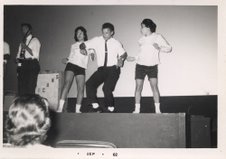
Before I went out on the road with Stomp, I played with a pair of dancers named Silk and Satin; the male dancer’s name was Claude Grant. My next job was on the road with Ida Clark and the Darktown Scandals; she made famous the song Wild Women Don’t Have the Blues. She had a bunch of teenagers in the band and we got no money; only five or ten dollars every once in a while.

One person on the show, a tremendous tap dancer named Ground Hog, should be documented. When he wasn’t dancing, he was the drummer and I didn’t know anything about playing bass, so he guided and kept me together. He was an African and he had one bad eye that seemed to wander. I was on tour with Ida Clark for three months and it seemed a very long time.

When I got home Stomp was ready for a bassist. On our first gig, we went to a popular spot in Dayton that all the musicians played (Note: According to Lester Bass, also a bassist, the likely spot was called Farm Dell, a barn located on Ruth Avenue, owned by the McLin Family, several generations of funeral directors and politicians. The business was a country club for active democrats and Elks Lodge members. The entertainers and bands included the top names in the business; Dizzy Gillespie, Paul Gaiden, Tiny Bradshaw, Lucky Milender, Buddy Johnson and Snookem Russell).

Some of our publicity photos have us pictured in tiger skin coats and we would even wear those things in July and August. They were really heavy and I would sweat and soak that coat so much that you could put a cigarette out on it and it wouldn’t burn.

I left Stomp Gordon’s Band because of misunderstandings that I don’t want to discuss; I just want to remember the good times, because we had so much fun. And the women.....! I met a woman named Marion in Minnesota and she was so good to me that I stayed in Minneapolis and the band went on, ending up in Anchorage, where he met Billie Holiday (December, 1954).

I got a call from Stomp from Green Bay, Wisconsin, as they were working their way back to Columbus. I remember it being at a time when snow on the ground was up to my waist; I had never seen anything like it before. His bass player wasn’t familiar with the show, so he asked me to come and join them.

That engagement was star time for me; I wasn’t really a bass player, I was a clown. I walked in and, since I knew all the material, I tore the place up. I walked around for a couple of weeks with my chest stuck out, but eventually it caught up to me and my ego got deflated. I remember the girls in Green Bay.

I eventually married and the settled, slowed down lifestyle was the best thing for me. I married a woman with children, and a daughter that I had with a relationship in Florida, eventually found me and became a good part of my life. I have a granddaughter that I enjoy.

The place that we made our name in Columbus was called the Musical Bar on Parsons Avenue in the Southend.

Note: Bruce Woody passed away June 19, 2008.

Friday, October 8, 2010

Edith Clark, pianist, Flytown resident


Edith Clark was a pianist and singer who I met once in the 1980s, doing a stint at the legendary piano bar called the Dell, on Parsons Avenue. I found her photo in the archives of the Columbus Call-Post, a Cleveland based Black newspaper chain that continues to serve Ohioans.  


I interned at the Call-Post in the early eighties and a book that Edith had written came into my possession, through my friend and fellow journalist Charles Briggs. In The Way, The Gifts and The Power, published in 1971 by New York's Vantage Press, Inc., Edith created an autobiographical character named Isobel Grant, who grew up in a community in Columbus called Flytown. Now known as the Arena District, the area was also the community where musicians Hank Marr and Ronnie Kirk, as well as Edith, grew up in the twenties and thirties.


Here is the narrative that begins on page thirty-six of The Way, The Gifts and The Power, describing the community in the 1920s;


"Flytown was a community singular unto itself. It nestled around the Ohio State Penitentiary, a stones throw from where the Olentangy and Scioto Rivers merge, a hop, skip and jump from the geographical center of Columbus. Bordering Long Street on the south, Flytown meandered along the edge of Front Street past Naughten, Maple and Vine, crossed the Pennsylvania Railroad tracks at Spruce, skirted down Goodale Street past the park, followed the street car line past Neil Avenue, cut through Henry Street to Buttles, then up to an undefined line which eventually ended at the Olentangy River to the West.


A railroad spur track ran behind Michigan Avenue to serve the many factories which lined the river; the Indianapolis Paper Stock Company, the Pipe factory, the Wire Works. The factory that made molds edged a big vacant lot where my father, Carl, and his cronies played baseball for barrels of beer. 

Past the mold company there was a small open field where the kids played and men kept their dump wagons. There was the Paste factory, the Piano company, the Vault company, the derrick makers, the stove factory, and on up towards First Avenue, the Oleo makers and the beer company. On Michigan Avenue, proper, there stretched the lumber company.


Carl was working for the Power and Light Company downtown when he mashed his thumb on the job and, taking pride in his male invincibility, ignored the soreness until it festered into gangrene and he lost part of his left arm, almost up to the elbow, in order to save himself from dying due to blood poisoning. 

With the money that he received as compensation for the lost of a limb, Carl and Reba, my mother, paid cash for a house further down Michigan Avenue.

By this time the bootlegging and highjacking Italians were becoming affluent enough to leave Flytown and move across the river into a newly developed suburb which began at Goodale Street. Our family was the first colored family on that block. Reba took great pride in jerking the "For Sale" sign as a symbol of an answer to some White neighbor who called to inform them that the house was not for rent; it was for sale.


Carnivals and medicine shows often set up on the baseball field on the corner of Poplar and Michigan in the summer time and the neighborhood reveled in the novelty of the show put on by the medicine man. The Godman Guild was the heart, the hub, the center around which revolved the community of Flytown. It taught the residents laws and ordinances, showed them the way wherein they must walk and brought their causes to the rulers of the city.


Long before the nation would be confronted with the same problem, the Godman Guild met and found solutions, faced squarely and honestly the needs of the neighborhood and welded the transplanted souls into a solid acknowledgment of pride in themselves and their community. The pillars of society of Flytown were as high-minded and respectable, virtuous and God-fearing as any people in any neighborhood; for their children they had the same goals as any human being in the nation."


Thanks to Edith Clark, we have a glimpse of Flytown, a community that ceased to exist in the 1960s when urban renewal and highway construction brought progress to the near Northside of Columbus.